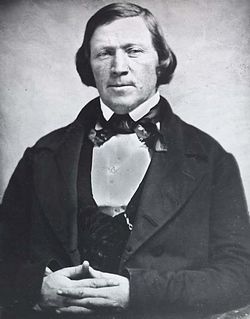
Brigham Young(born 1801)
was Joseph Smith's
immediate successor and thus the second
prophet and president of The Church of Jesus Christ
of Latter-day Saints.
Various Biblical like titles were
used to acclaim him.
"The American Moses" or "The Mormon
Moses" because, like the biblical figure, he led
his followers in a long and
dramatic exodus through a desert, to what
they saw as a "promised land".
(Utah) He was also dubbed "The Lion
of the Lord" for his bold personality.
Originally a Methodist he
converted to Mormonism after reading The Book of
Mormon
In 1845 - the year after
Smith's violent death - Brigham Young
persuaded some 5,000 to 6,000 peopleto
leave Nauvoo the following year in order
to seek a new home in the American wilderness.
The residents of Nauvoo rose
up against them and the Mormons suffered the fury of mob
violence. The
Nauvoo Mormon Temple was burnt several years later and finally
destroyed by the town's residents two decades later.
Many of the Mormons
crossed the Mississippi river early in
February, 1846, and later that month
Brigham Young and his family
also set out. He
was chosen president in the "Camp of
Israel " and then captains of
tens, fifties and hundreds were
appointed to conduct the march.
When they arrived near what is now Florence,
Nebraska, in July 1846, the Omaha and
Pottawattamie Indians received them kindly, even
urging the
Mormons to establish a
camp in their midst. Brigham Young
accepted this offer after obtaining the consent of President Polk,
and made his winter-quarters there.
In April, 1847,
Brigham Young, with 142 men, set out in
search of a suitable place for a final
settlement.
They entered Salt Lake valley
in Utah on 24 July, 1847,
and, after a survey the first house was
erected. Eventually it grew to become Salt
Lake City.
On September 11th 1857,
at least 127 men,
women, and children were massacred as they
crossed Mormon land by wagon train - by order of the leadership of the
Mormon Church under Brigham Young.
Bishop John D. Lee,
Brigham Young's bodyguard, and an officer
in the Mormon militia, became the scapegoat
was eventually executed for the massacre.
It was the second biggest ever massacre of Americans by
Americans. Only the Oklahoma bombing surpassed this event in deaths.
On May 1, 1857, a train of over forty wagons,
several carriages, 1000 head of cattle, hundreds of horses, and
about 142 pioneer men, women and children left Arkansas for
California. On Tuesday morning,
September 8, 1857 the Indians attacked the emigrants, killing
seven men and wounding sixteen others before they were turned
back. The pioneers withstood the attacking Indians for four
days, leaving the pioneers with no water and their ammunition
nearly gone. Bishop John D. Lee approached the train under a
flag of truce and convinced the pioneers that he had persuaded
the Indians to let them go if they would leave their wagons and
possessions to the Indians. After deliberating, the suffering
group could find no other way out and they agreed. The pioneers
were told that it should appear to the Indians that they were
the Mormon's prisoners. Lee sent in a wagon and the emigrants'
weapons were loaded in to it. The wounded were then loaded into
two wagons and two other wagons were loaded with the youngest of
the children. These wagons left first followed by the women and
older children on foot. The men were lined up single file, and
parallel to a single file of Mormon Militiamen and this group
followed about a quarter of a mile behind. As the group moved
out, the waiting Indians moved in and began to loot the goods
the pioneers had left behind. A short distance later, Lee rose
up in his stirrups and shouted "Do your duty!" and each Mormon
shot the member of the train standing next to him. At about the
same time up ahead, Mormon Militia disguised as Indians, and the
real Indians, moved in on the women and older children,
shooting, clubbing and axing them to death.
No effort was made to give the bodies a decent burial.
Foraging animals scattered the bones over a great distance. In
1859, a passing detachment of U.S. Cavalry stopped and gathered
what bones they could find into one grave. A rock cairn was
erected with a carved stone and the words "Here lie the bones of
one hundred and twenty men, women and children from Arkansas,
murdered on the 10th day of September, 1857." An officer painted
a cross-line beam above the cairn with the words "Vengeance is
mine, saith the Lord. I will repay."
The two wagonloads of children who had not been killed were
adopted into Mormon homes. It is believed that 18 of the
children survived. In 1859, Captain James Lynch of the U.S. Army
took possession of these young survivors and returned them to
relatives in Arkansas. Although there were many investigations,
no punishment was handed out for the crime until 20 years later.
Lee wrote out a full confession and was found guilty and
sentenced to death by firing squad.
"The
Mountain Meadows Massacre stands without a parallel amongst
the crimes that stain the pages of American history. It was
a crime committed without cause or justification of any kind
to relieve it of its fearful character... When nearly
exhausted from fatigue and thirst, [the men of the caravan]
were approached by white men, with a flag of truce, and
induced to surrender their arms, under the most solemn
promises of protection. They were then murdered in cold
blood" -William Bishop, Attorney to John D. Lee
"I had many to assist me at the Mountain
Meadows. I believe that most of those who were connected with the
Massacre, and took part in the lamentable transaction that has
blackened the character of all who were aiders or abettors in the
same, were acting under the impression that they were performing a
religious duty. I know all were acting under the orders and by the
command of their Church leaders; and I firmly believe that the most
of those who took part in the proceedings, considered it a religious
duty to unquestioningly obey the orders which they had received.
That they acted from a sense of duty to the Mormon Church."
- Life
and Confessions of John D. Lee
Joseph Smith - who had somewhere between 27 and 84 wives
- introduced
the principle of Polygamy to Brigham Young, was in
turn was a keen devotee of this 'divine doctrine'
He said..
"The only men who become Gods, even the Sons
of God, are those who enter into polygamy" (Journal
of Discourses 11:268).
"Some of these my brethren know what my
feelings were at the time Joseph revealed the
doctrine; I was not desirous of shrinking from
any duty, nor of failing in the least to do as I
was commanded, but it was the first time in my
life that I had desired the grave, and I could
hardly get over it for a long time. And when I
saw a funeral, I felt to envy the corpse its
situation, and to regret that I was not in the
coffin, knowing the toil and labor that my body
would have to undergo; and I have had to examine
myself, from that day to this, and watch my
faith, and carefully meditate, lest I should be
found desiring the grave more than I ought to
do." [page
100 of "Brigham Young - American Moses" by
Leonard J. Arrington]
What follows is a listing
of Brigham Young's wives.
An asterisk indicates "a wife not recognized in
traditional histories, even though there is evidence
of at least one of the following: the ceremony,
sexual cohabitation, or a formal divorce"; names in
parenthesis are the surnames of previous husbands;
"divorce" indicates a formal dissolution of the
marriage through secular or ecclesiastical
procedures; "remarried" indicates later marriage of
the wife to another husband. See D. Michael Quinn,
The Mormon Hierarchy: Origins of Power,
Signature Books, Salt Lake City, 1994, 685 pages,
ISBN 1-56085-056-6; Appendix 6, "Biographical
Sketches of Officers of the Church of Jesus Christ
of Latter-day Saints, 1830-47" pp. 607-608).
Miriam Work 1824 (2 children), included in
his will.
Mary Ann Angell 1834 (6 children), in will.
Lucy A. Decker (Seeley) 1842 (7 children),
in will.
Harriet E. Cook (Campbell) 1843 (1 child),
in will.
Lucy Augusta Adams (Cobb) 1843 (no
children), requested cancellation of her sealing
1846, sealed by proxy to Joseph Smith 1848, from
1850 onward asked Brigham Young to give her to
various men in civil marriage but still included
in will.
Clarissa C. Decker 1844 (5 children), in
will.
Clarissa Ross-Chase 1844 (4 children), in
will.
Louisa Beaman (Smith) 1844 (5 children).
Zina D. Huntington (Jacobs, Smith) 1844 (1
child), in will.
Emily D. Partridge (Smith) 1844 (7
children), in will. (daughter of Edward
Partridge)
Eliza R. Snow (Smith) 1844 (no children), in
will.
*Elizabeth Fairchild 1844 (no
children), divorced 1855.
*Clarissa Blake 1844 (no children).
*Rebecca W. Greenleaf Holman 1844 (no
children).
*Diana Chase 1844 (no children),
separated about 1848, remarried 1849.
Maria Lawrence (Smith) 1844 (no children),
separated 1845, remarried 1846.
Susannah Snively 1844 (no children), in
will.
Olive G. Frost (Smith) 1844 (no children).
*Mary A. Clark (Powers) 1845 (no
children), divorced 1851.
*Mary Harvey Pierce 1845 (no
children).
Margrette W. Pierce (Whitesides) 1845 (1
child), in will.
*Rhoda Richards (Smith) 1845 (no
children). (she was Young's 1st cousin)
Emmeline Free 1845 (10 children), in will.
(former fiancé of John D. Lee, her sister Louisa
married Lee).
Mary E. Rollins (Lightner, Smith) 1845 (no
children), remained with legal husband yet
considered herself deserted by Brigham Young
1846.
Margaret Maria Alley 1845 (2 children), in
will.
*Mary Ann Turley 1845 (no children),
divorced 1851.
*Olive Andrews (Smith) 1846 (no
children).
*Emily Haws (Chesley, Whitmarsh) 1846
(no children), separated 1848.
Ellen A. V. Rockwood 1846 (no children).
*Abigail Marks (Works) 1846 (no
children).
*Mary E. Nelson (Greene) 1846 (no
children).
*Mary E. de la Montague (Woodward)
1846 (no children), divorced and returned to
legal husband 1847, then returned to Brigham
Young 1851.
*Amy C. Cooper 1846 (no children).
*Julia Foster (Hampton) 1846 (no
children), separated 1846, married another man,
returned to Brigham Young 1855 only to leave him
bitterly later.
*Abigail Harback (Hall) 1846 (no
children), returned to legal husband 1846.
Naamah K. J. Carter (Twiss) 1846 (no
children), obtained cancellation of her sealing
by 1871, anointed to deceased first husband but
still included in will.
*Nancy Cressy (Walker) 1846 (no
children).
*Eliza Babcock 1846-53 (no children),
divorced 1853.
*Jane Terry (Tarbox, Young) 1847.
Mary J. Bigelow 1847 (no children), divorced
1851.
Lucy Bigelow 1847 (3 children), in will.
*Sarah M. Guckin (Malin) 1848 (no
children).
Eliza Burgess 1852 (1 child), in will.
*Mary Oldfield (Kelsey) 1852 (no
children).
*Catherine Resse (Clawson, Egan) 1855
(no children).
Harriet E. Barney (Sagers) 1856 (1 child),
in will.
Harriet Amelia Folsom 1863 (no children), in
will.
Mary Van Cott (Cobb) 1865 (1 child), in
will.
Ann Eliza Webb (Dee) 1868 (no children),
divorced 1875; her story was fictionalized in
Irving Wallace's 1962 novel The
Twenty-Seventh Wife.
*Elizabeth Jones (Lewis, Jones) 1869
(no children).
*Lydia Farnsworth (Mayhew) 1870 (no
children).
*Hannah Tapfield (King) 1872 (no
children).
[extract
from Brigham Young on
Wikipedia encyclopaedia]