To be eligible for the Shriners one must be a 32nd
or 33rd degree Mason.
This is an official article,
part of a series, explaining Masonry to the public..
The
Ancient Arabic Order of the Nobles of the Mystic Shrine for
North America is an international fraternity of approximately
800,000 members who belong to 190 Shrine Temples through-out
North America. Thirteen Masonic brothers founded the Shrine in
New York City in 1872 on the basis of the Masonic principles of
brotherly love, relief and truth, adopting the
requirement that only a 32nd degree Scottish Rite
Mason or Knights Templar York Rite Mason can petition to become
a Noble of the Mystic Shrine.
The basic organizational unit of the Shrine is
the Temple, which is governed by an elected board called the
Divan. The Divan is headed by the Potentate, who is the
presiding officer of the local Temple. All Shrine Temples are
subordinate to the Imperial Council, which meets annually. The
Imperial Council is composed of representatives elected by each
Temple, all past and present Imperial officers, and emeritus
representatives. The Imperial Divan, the Shrine's governing
board, is headed by the Imperial Potentate, the Shrine's highest
officer and consists of 13 elected officers. A new officer is
elected to the Imperial Divan each year and moves up one rung in
succeeding years. Only the Imperial Treasurer and Imperial
Recorder do not move up the Imperial line, but are generally
re-elected to their current posts.
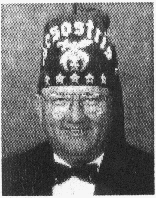
The best known symbol of Shrinedom is the
distinctive red fez that all Shriners wear at official
functions. (see photo above) The fez derives its name from
the of Fez, Morocco, and was chosen as part of the Shrine's
Arabic (Near East) theme, which was developed by
the two men who were the driving force behind the new order:
Billy Florence, a popular actor, and William Fleming, a
prominent New York physician. Both men knew the fledgling
fraternity needed an appealing backdrop against which the
color and pageantry of the Shrine could be played
out.
Legend says that Florence conceived of the
Arabic theme when he attended a party in Marseilles, France,
hosted by an Arabian diplomat. At the end of the party, the
guests became members of a secret society in an elaborate
ceremony. Florence realized that this might be the ideal vehicle
for the new fraternity, and he made copious notes and drawings
of the ceremony.
When Florence returned to the states, he
showed his material to Fleming, and together the two men created
the rituals, designed the emblem and costumes, and formulated
the salutation. The first Shrine Temple Mecca Temple was
organized in New York City, and the new fraternity was on its
way. The turn of the century brought a dramatic increase in
Shrine membership and a growing desire for an official Shrine
philanthropy. Individual Temples had always supported various
charitable causes, but now the Shrine was ready for its own philanthropic
cause. Thus was born, in 1922, the first Shriners Hospital for
Crippled Children, dedicated to providing excellent medical
care to children with orthopaedic diseases and injuries. at no
cost to the patients, their parents or any third party.
The concept was so successful, and the
potential for helping children so great, that additional
Shriners Hospitals followed the first, and the Shrine's hospital
network grew rapidly. In 1936, the hospital network had expanded
to the point that the Shrine separately incorporated its
philanthropy, creating a wholly distinct charitable corporation
to distinguish its philanthropic activities from its fraternal
activities.
During the 1950s, Shriners began looking for
other ways they could help children, and they became aware of
the lack of medical expertise in burn care. Each year, thousands
of children are crippled, disfigured or killed by this tragic
hazard of childhood.
Thus, forty years after opening its first
Shriners Hospital for Crippled Children, the Shrine opened its
three Shriners Burns Institutes, each with a three-fold purpose
of helping children, conducting burn research and training
medical personnel in the treatment of burns.
Today, there are 19 orthopaedic Shriners
Hospitals ahd three Shriners Burns Institutes located throughout
the United States, Canada and Mexico. All 22 Shriners Hospitals
adhere to the principles laid down in 1922 - all care would be
free to any child under 18 (originally 14) in need of
orthopaedic or burn care, with only the condition that treatment
at another facility would place a financial burden on the
family.
Today, the Shrine and its hospitals, while
maintaining their separate legal and financial identities, are
inextricably linked through the Shrine's founding and support of
Shriners Hospitals, and Shriners Hospitals for Crippled Children
have become known as the "heart and soul of the
Shrine."

 Databank index